Official Website for paper
Hiding in Plain Sight: Camouflaging Real-world Objects (accepted by IEEE TVCG on June 20th, 2026)
Dong-Yi Wu Tong-Yee Lee, Senior Member, IEEE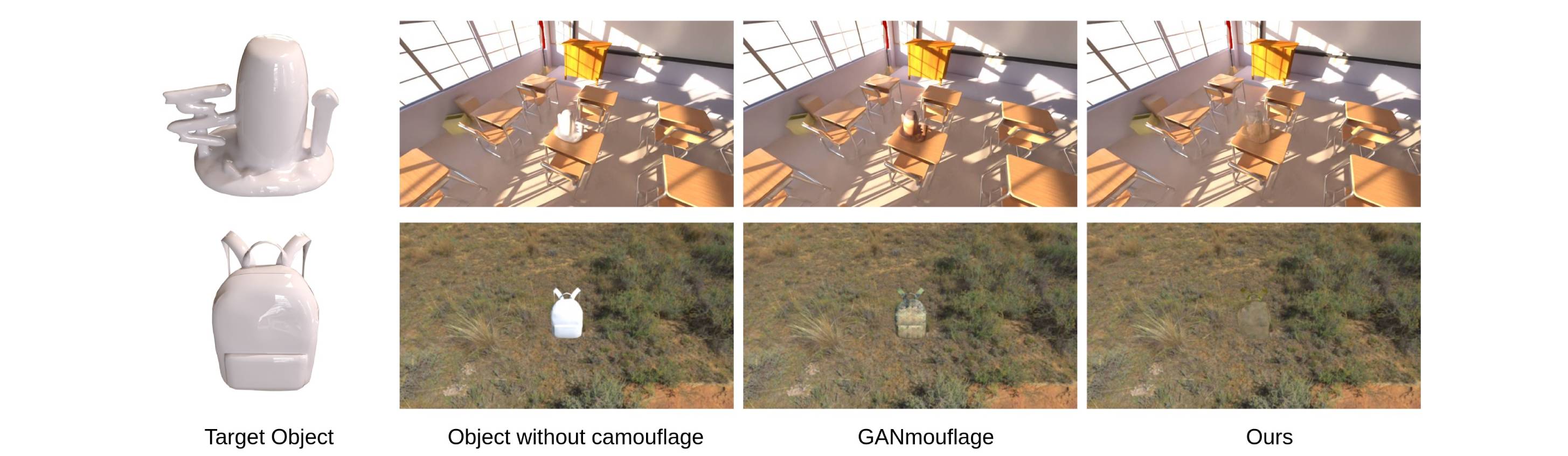
Abstract
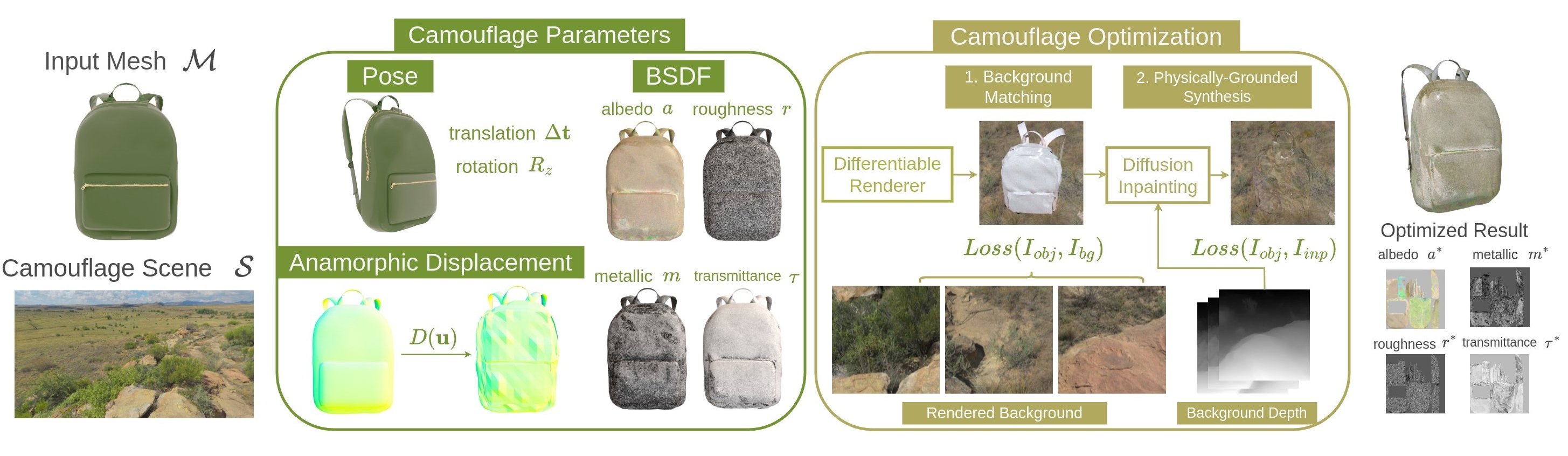
Camouflage, a survival strategy perfected by nature, enables organisms to evade detection by blending seamlessly into their surroundings across multiple viewpoints. Replicating this remarkable ability in artificial settings remains a formidable challenge. While recent computational methods have advanced 2D camouflage, extending concealment into 3D is far more difficult: a single texture must reconcile drastically varying backgrounds, making effective camouflage across all views highly challenging. Prior approaches attempt to address this by designing multi-view textures, but their appearance representations are too simplistic to cope with strongly conflicting backgrounds and fail to account for physical light transport, resulting in breakdowns under realistic illumination. We introduce a new paradigm that formulates 3D camouflage as a multiview inverse rendering problem. Instead of treating concealment as texture synthesis, we directly optimize appearance within a physically based rendering framework, explicitly modeling reflections, shadows, refractions, and other complex light interactions. Our approach expands the solution space by combining BSDF-based material representation with anamorphic surface displacement, enabling camouflage that adapts naturally to both viewpoint and illumination changes. Through tailored loss functions and optimization strategies, our method produces results that are not only perceptually convincing but also physically consistent, marking a significant step toward practical, real-world 3D camouflage. Experiments demonstrate that our physically grounded formulation achieves robust concealment across diverse viewpoints and lighting scenarios, substantially outperforming prior image-based methods.
Demo Video
Contact Us
tonylee@mail.ncku.edu.tw
cutechubbit@gmail.com
Computer Graphics Laboratory, Dept. of Computer Science and Information Engineering, National Cheng-Kung UniversityDean & Letter

Temporibus autem quibusdam et aut officiis debitis aut rerum necessitatibus saepe
Startup Framework

Temporibus autem quibusdam et aut officiis debitis aut rerum necessitatibus saepe
Lamp & Velvet

Temporibus autem quibusdam et aut officiis debitis aut rerum necessitatibus saepe
Smart Name

Temporibus autem quibusdam et aut officiis debitis aut rerum necessitatibus saepe
Fast People

Temporibus autem quibusdam et aut officiis debitis aut rerum necessitatibus saepe